My adventures continue
My heart is heavy as I am about to continue my travels without my love, Scott. He was my wonderful travel companion. Alway so interested in meeting new people, history, experiencing life to the fullest. I will miss his smile, sense of adventure and love. Scott died, July 29, 2022 after a courageous battle with prostate cancer. I know he will be with me every step of the way and he would want me to enjoy more adventures. I will miss you my love.
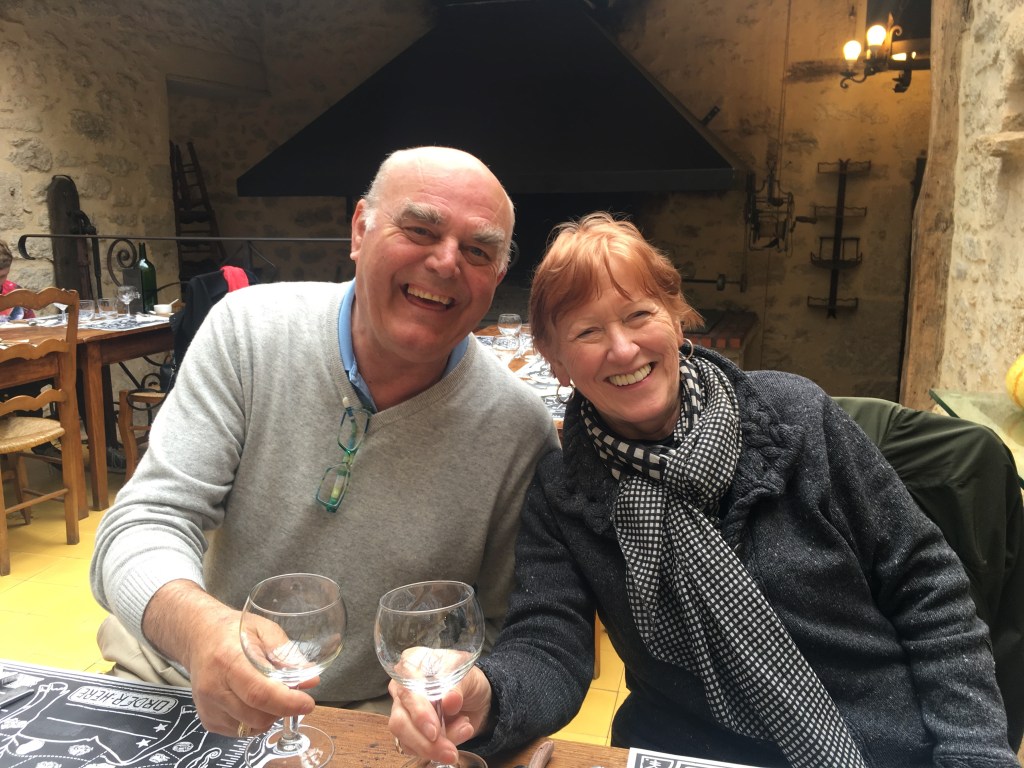
Barcelona – September 22 – 29, 2022
I am taking an unexpected trip to Barcelona! Scott and I never traveled to Spain so it is a new country to experience. Susie, my good friend and nursing school classmate, decided not to go to Spain with her husband Tom who is taking a biking trip starting out in Barcelona. He wanted to go early and experience the city with Susie. Originally he asked me to go early and stay with her while he was gone. Susie decided she did not want to go and Tom came up with the idea that I would go with him. I have known them both since the 60’s, we have attended our children’s weddings and Scott and I have spent time with them. So, I decided to go with him and have a Barcelona adventure!
We only decided this and have been planning the trip since August 29th. It has been fun deciding what we want to do, where we’ll stay, places we want to see and of course where we will eat!!
We leave September 22nd, Tom travels from Wausau to Chicago and on to Barcelona arriving at 9 am on the 23rd. I travel from Minneapolis to Amsterdam and then on to Barcelona arriving at noon. We are sharing a two bedroom Airbnb, a first for Tom as he and Susie usually stay in hotels when they travel. On the 29th, Tom will leave for his biking trip and I will head back to Minneapolis.
We have lots of places to see and adventures so stayed tuned!
Friday 23 September
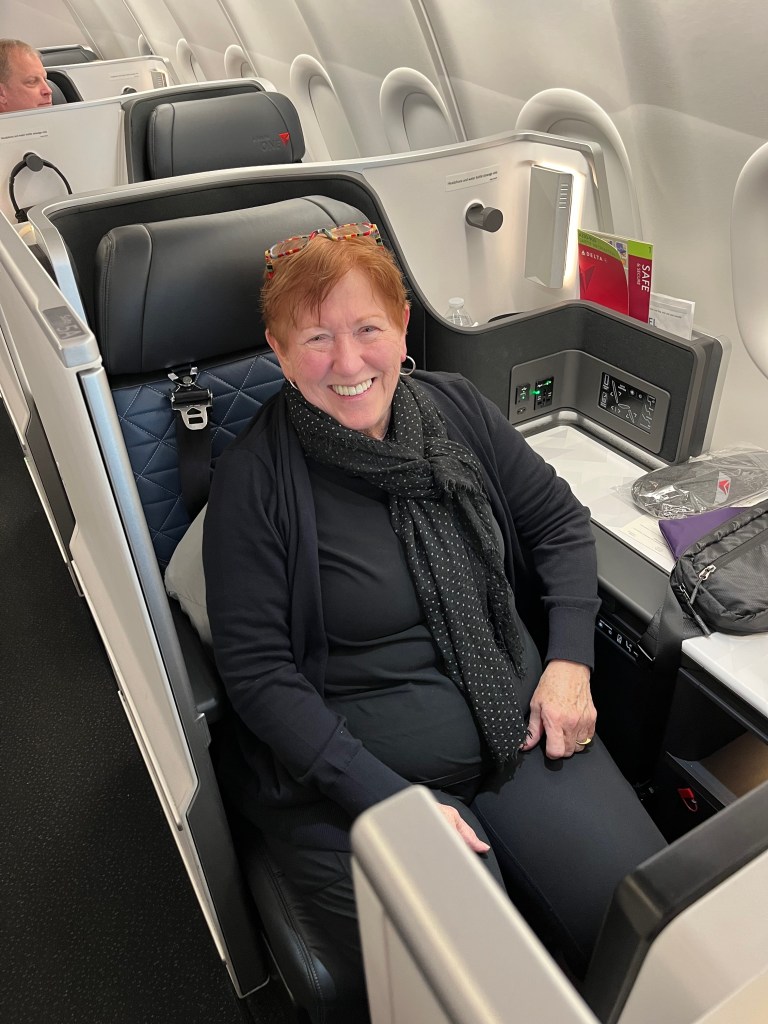
My flight was wonderful. I treated myself to a mileage upgrade and loved it!!! Dinner was a great trout with an orange sauce and a really good cream of mushroom soup. They had some really good salted butter for the bread. To top it off I had a chocolate sundae topped with Scott’s favorite Biscoff Cookies! So he is was near by!
I arrived in Barcelona at 12:30 pm and at the apartment at about 2:30. Tom was waiting in the coffee shop trying to stay awake. I forgot to mention that Tom is a believer in Rick Steves tour books, suggestions for things to do and places to eat. I call him Rick Steves Jr.!
Martin met us at the apartment and checked us in. The apartment is only a few blocks from the Sagrada Familia. The apartment looked good and the balcony was very nice (always something I love!). We dropped our bags and decided to try and do the Hop On/Hop Off Bus. It stopped in front of the Sagrada Familia. However, our first big challenge was locking the door!! Oh, you say, easy enough but it was a double lock system. Turn left til it clicked, turn again and yes, it should have closed. But no, it wouldn’t close. We struggled with it for at least 5 minutes. After a lot of laughter it closed. We were not quite sure why. Oh well, we’d deal with opening it when we got home. An yes, we still struggled even thought we both tried it at least twice.
The Hop On/Hop Off bus proved to be another adventure. Everyone had to wear a mask on the bus, at least to get on. Really no consistency and no real enforcement except when boarding. We started at the Sagrada. We saw the picture and heard him describe it but that was about the last thing we understood. We kept trying to find the place he was talking about and we never found it or we found it after we had passed it. We also had a hard time understanding him. I did not take many pictures because the bus was moving and I was not sure what I was seeing.
Things we did see were the Sant Pau Cathedral, the 100,000 capacity Soccer stadium, several places Gaudi designed and some palaces the descriptions I was not able to understand.
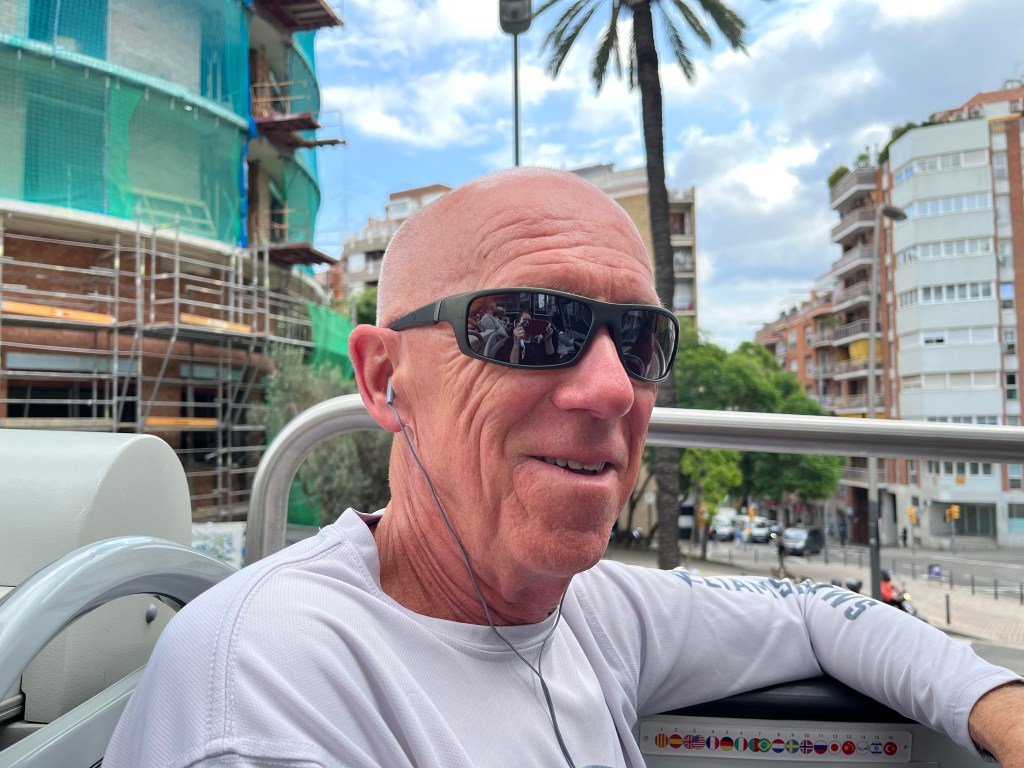
This is Tom on the bus.
After the tour was over we went back to the apartment to regroup. We did not want to go far to eat so I found a restaurant in our neighborhood called Aitor. It got 4.2 stars on Google. It was not a 4.2 star restaurant in either my mind or Tom’s mind either. We ordered some white wine and then finally understood that we had to go inside, get a plate and select the tapas we wanted. They were about 1,80 Euros a piece. Rick Steves says that they know how many tapas you have had by the number of toothpicks that are on the plate and sure enough the waiter mentioned that.
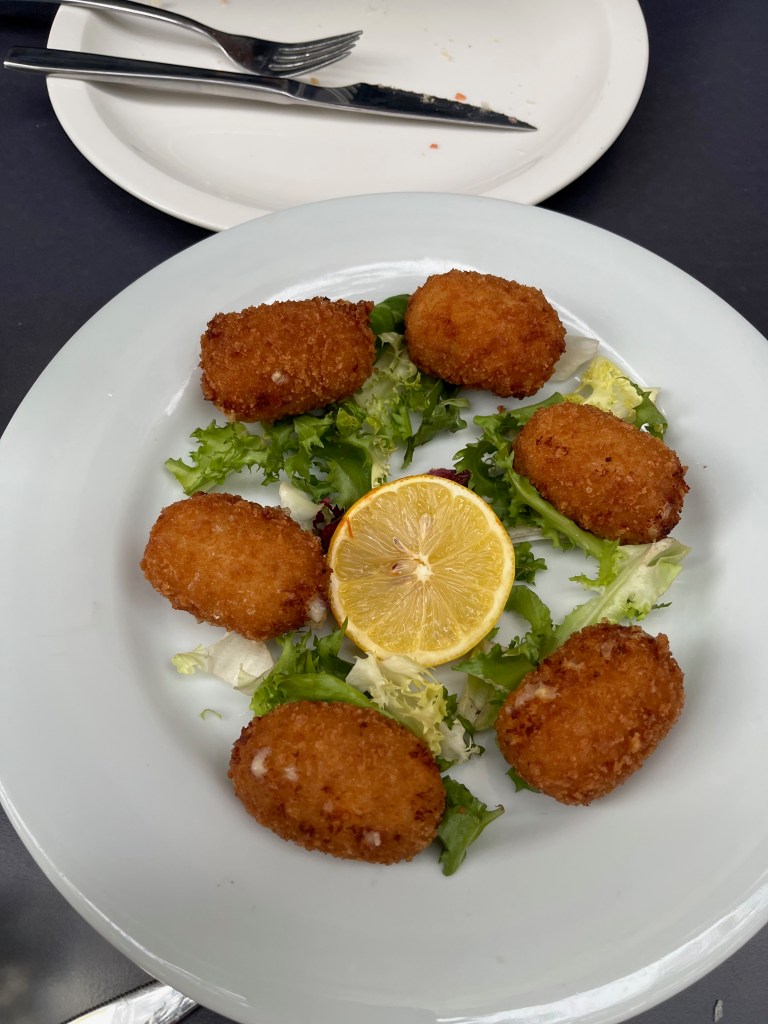
Imberico ham croquetas
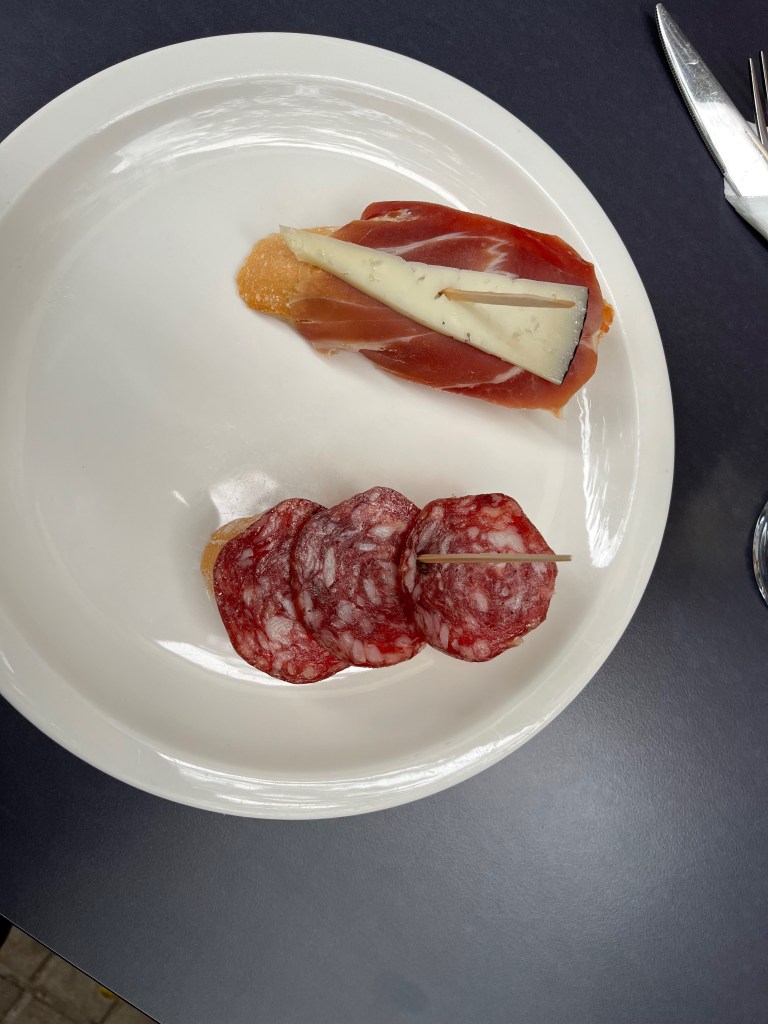
Copa Cantarinas Verdejo and Ibérico ham tapas.
Anyway the white wine was too acidic, the béchamel sauce in the croquetas was too thin and tasted awful and not very good BUT the ham and salami tapas were fine. Certainly nothing to merit a 4.2 star rating. We left half glasses of wine and 3 of the 6 croquetas and we left to find some good wine, cheese and meats. We were successful! We selected a Catalan red wine and meat and cheese.
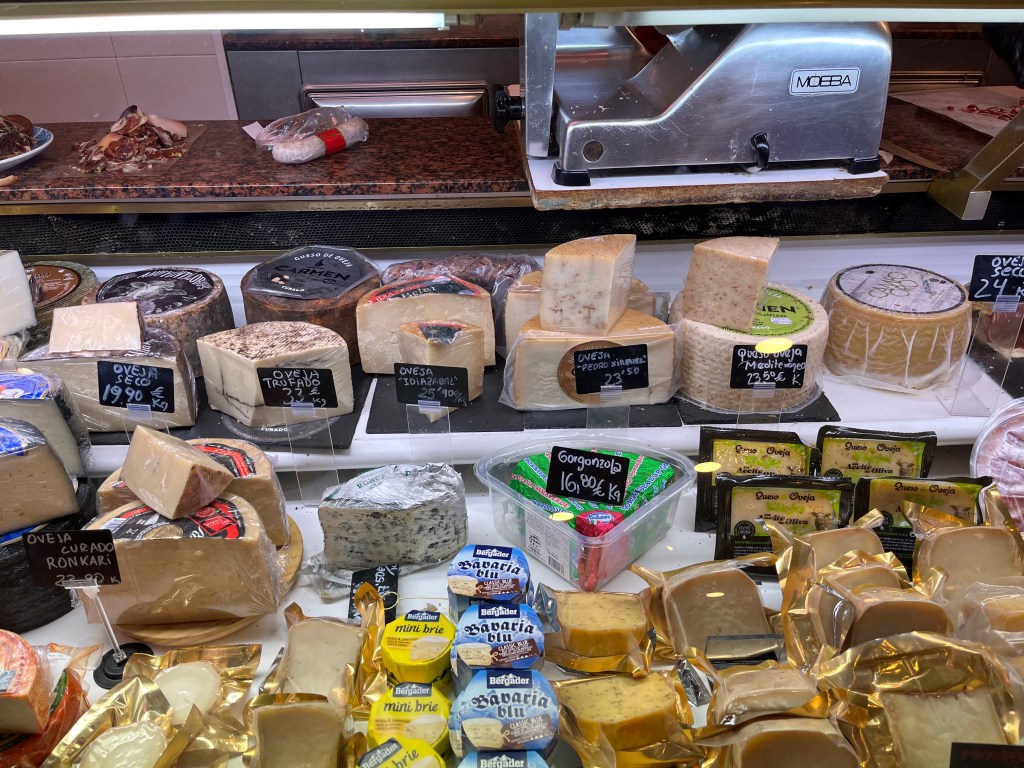
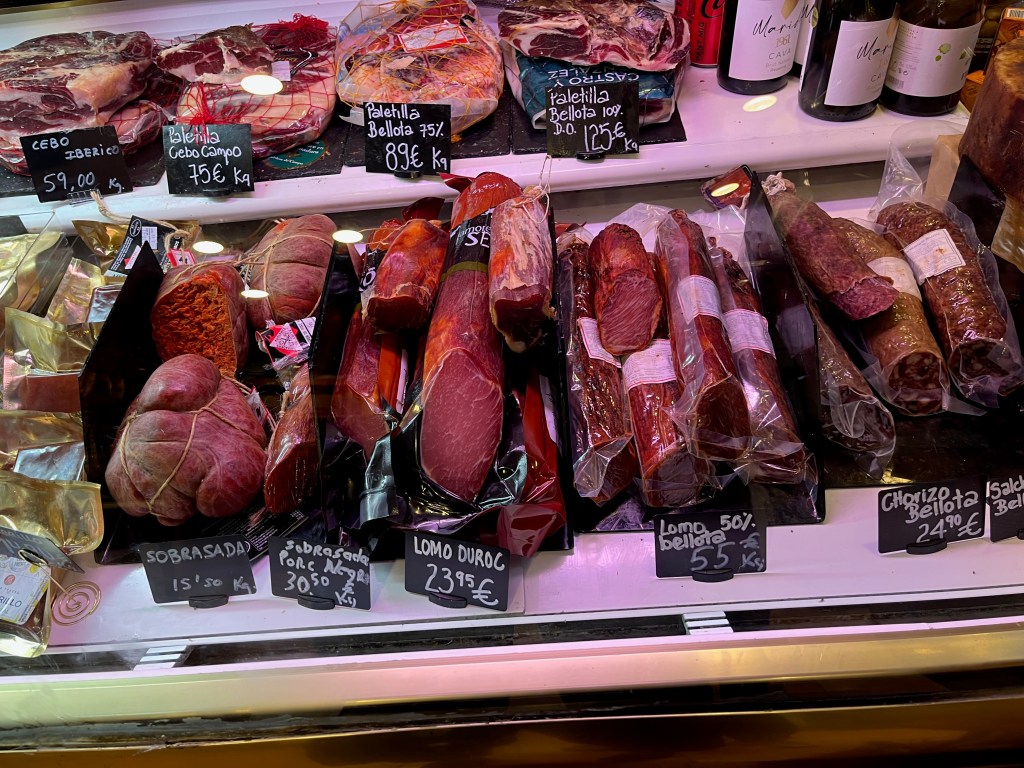
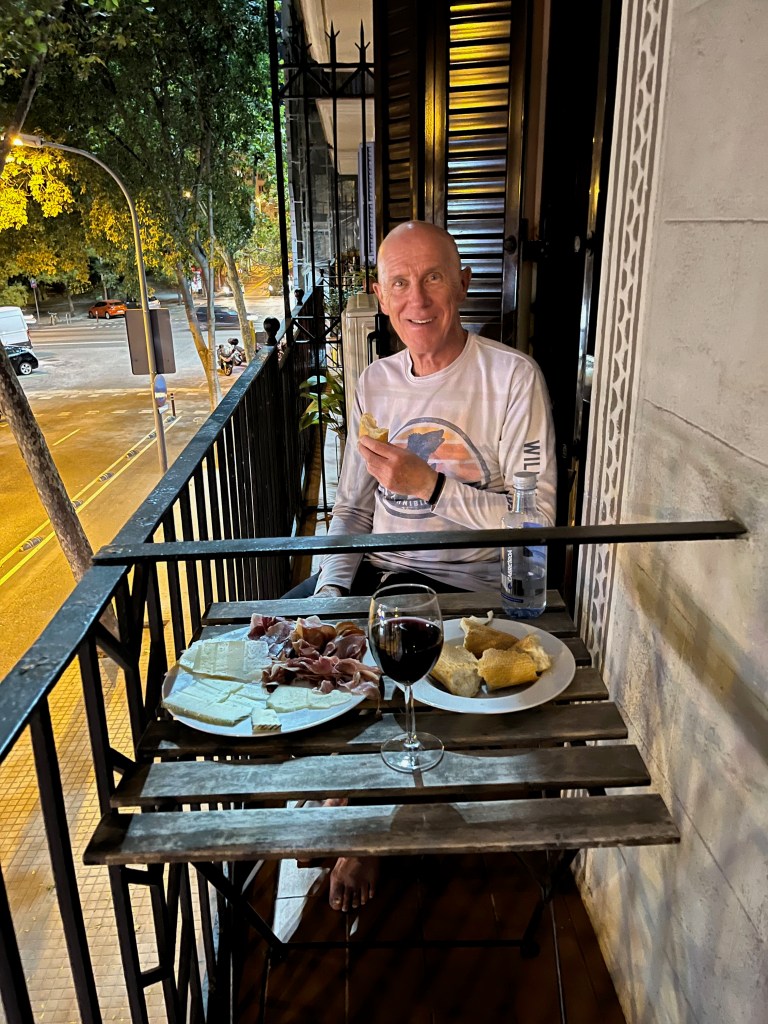
We took home our dinner finds, sat out on the balcony and had a “real” dinner. It was wonderful. Great conversation, good food and great company. A good start to our trip.
Saturday, 24 September
Walking Tour with Rosa, Festival and the Giants Parade, Great Lunch and Getting to Dinner Around Police and Fire Trucks
We met Rosa in front of the Olivia Plaza Hotel at the Catalunya Square. We found out it’s not always easy to follow Google maps on my phone, back and forth until we found the square. This is the Catalunya region of Spain. They have a separate flag and language. Rosa lives in a neighborhood within the City of Barcelona similar to my Fulton neighborhood in Minneapolis. When she was young her mother would always say “we’re going to Barcelona” when they already lived there. She also explained that when she was in school they taught Catalan but her mother learned Spanish. The languages are similar but not the same. We observed this in many of the signs, menus and other postings around. During Franco’s dictatorship (1939–1975) the use of Catalan was banned in schools and in public administration.
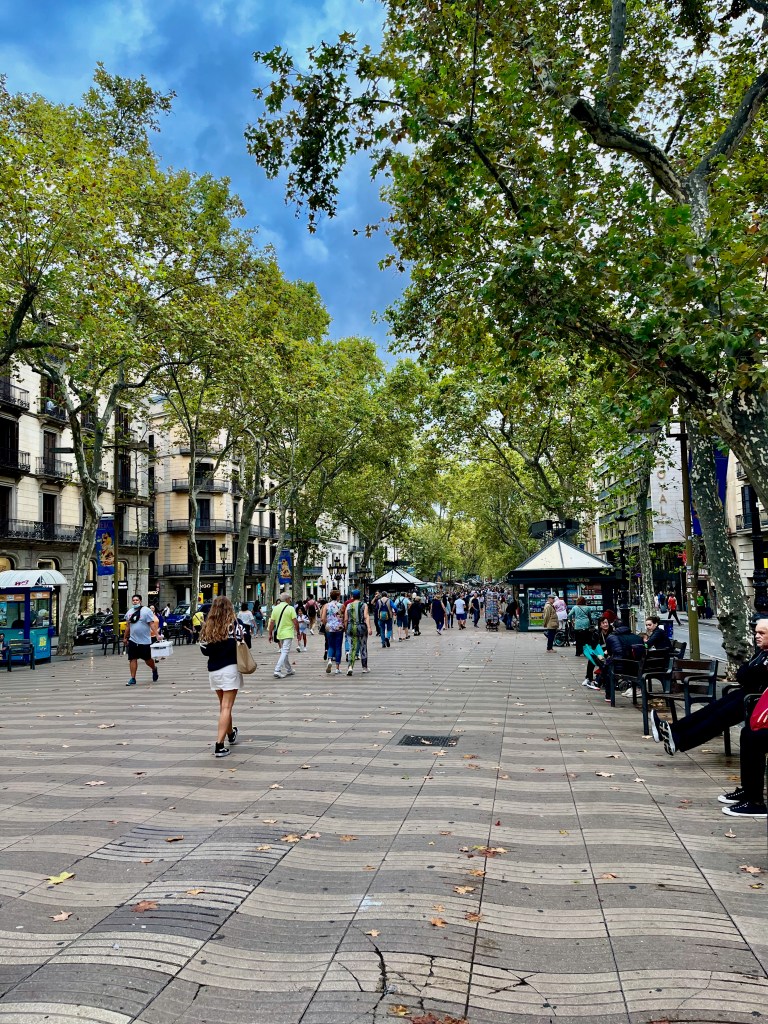
We started to walk down one of Barcelona’s main boulevards, the Ramblas. It runs from Place de Catalunya to the sea. It is lined with Plane Trees that provide shade in the summer and let sun in during the winter.
The Ramblas – Note the wavy tiles. This is to simulate waves going to the sea.
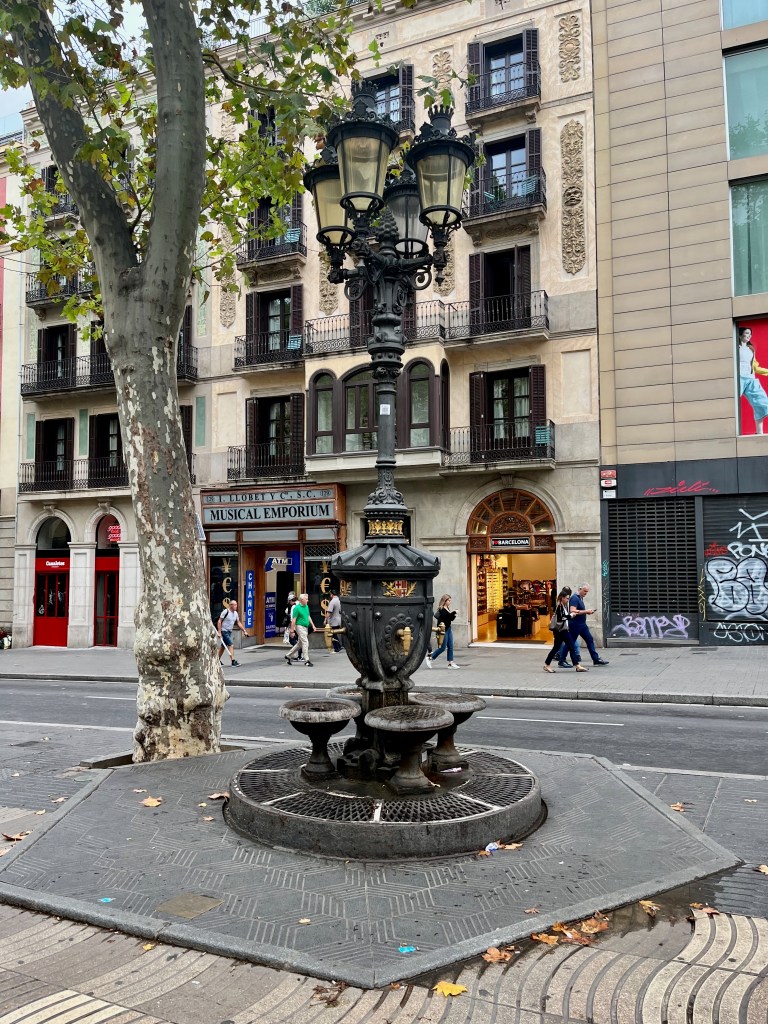
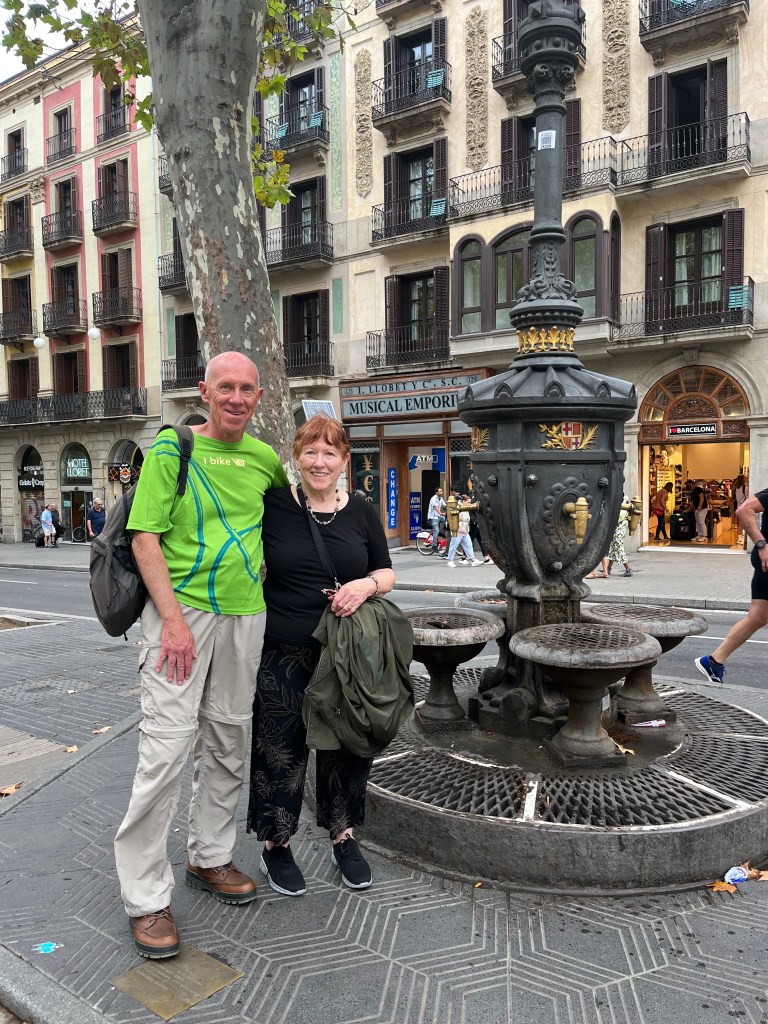
Rosa pointed out the Fountain of Canaletes. Legend has it that if you drink from the fountain it ensures you’ll come back to Barcelona one day. It is also a popular place for fans of the Barcelona soccer team to party after winning a big game. Rosa told us that they show big matches on screens here and it is mobbed during big games.
e back???
We next passed the Church of Betlem (Bethlehem) an example of baroque architecture. Rosa told us during Christmas there are several stable scenes inside the church.
One of two main doors.
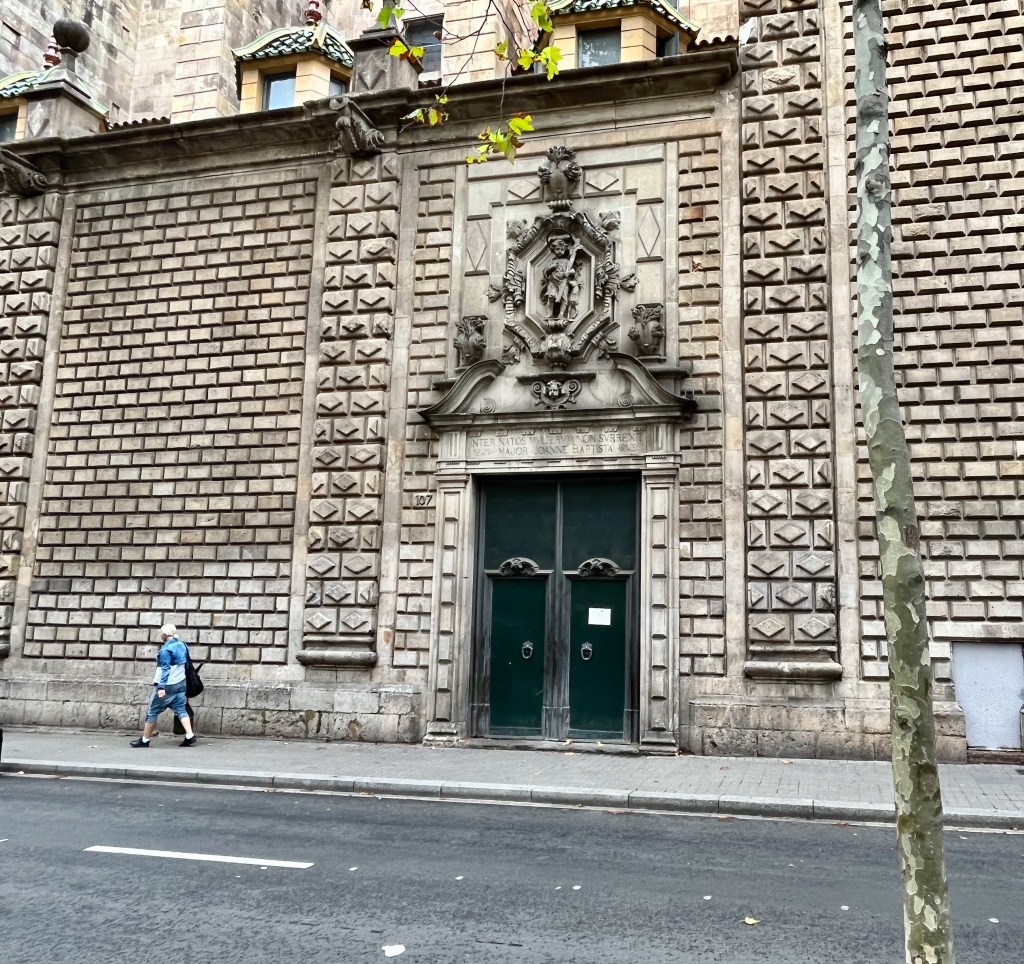
Baptista entrance.
We walked further and passed flower stalls, the La Boqueria Market, palaces and church towers. The La Boqueria Market was closed because of the holiday (more later). This market is the largest one and visited by most tourists. We will visit it later.


More images from our walk.


We decided we needed a break for coffee at one of Rosa’s favorite places the chocolate shop, Granja La Pallaresa. It smelled like chocolate and sweet treats.

Walking further we passed several of these plaques on building along the way. Beautifully done.


We encountered the street festival, La Merce Festival. This event is one of the highlights of the Mercè festival and takes place in Plaça de Jaume. It started in 1902 to say goodbye to summer and welcome in autumn.
Thousands of people pack the streets and the square to see the Castellers. The aim of the Castellers is to build a human tower and have a young child climb to the top of the tower and stand up. It requires a tremendous amount of planning and teamwork to build a human tower and it is quite an amazing sight to see. It is a competition and each group represents a different neighborhood and tries to get higher than the next. The tower has three parts: The base which is largest and stabilizes the structure. Next are the rings which have specific number of people depending on the height. Finally, the tower dome. The smallest and lightest person is on top. That person has to raise their arms to salute the crowd. Rosa explained that the tower depends on the base which represents the cooperation we all need to survive. Unfortunately, the square was so packed we could only see a smaller version of one of the towers. This photo is from the internet.
The Giants parade is a popular event for the whole family. Huge giants with effigies of kings, queens and nobles march through the streets. These huge figures tower above the crowds and spin around and around so the crowds can see them in all their glory. The Parade is often accompanied by small percussion groups that beat out a rhythm on drums as the Giants go by. There are also fat head or Capgrosses. These Giants represent the different neighborhoods of Barcelona. Each Giant is carried by one person and they are heavy. When they stop they are able to sit on a bench which is part of the structure.


Dancing figures. Scott would have enjoyed the dancing pigeons!
Giants marching down the street. A fisherman and his wife.

We left these festivities to walk to see the old Roman walls.

As some of you know I am interested in the history of Jews in Europe. A little history of Jews in Spain. Archaeological evidence suggests that there was a Jewish community in Barcelona as early as the first century AD, shortly after the city was founded. At first, Jews were allowed to live wherever they chose but during the Middle Ages, they were confined to a small area just inside the city walls called El Call. They had to enter and exit through a small gate. Eventually, during the Spanish Inquisition (1492 and 1502) Jews and Muslims were ordered to convert to Catholicism, be executed or leave. They fled to Portugal, France or North Africa. Before the Spanish Inquisition in the 15th Century about 300,00 Jews lived in Spain. Today an estimated 13,000 to 50,000 Jews live in Spain.
We walked toward the Roman wall and Passeig del Born.
Roman wall from about the 4th Century and a doorway in the wall.
The Passeig del Born has been El Born’s center for thousands of years. At one end is the church above and at the other end is the neighborhood market.
This is the Monument of Catalan Independence. The square is called Place del Fossar de les Moreres (The Burial Place of the Mulberry Tree). The lone mulberry tree (see part of the tree on the left above) and modern monument honor a 300 year old massacre which happened in 1714. Catalans still remember this today. The square marks the site of a mass grave of the massacred Catalans. An eternal flame burns atop.
Well, it was time to end our tour. We said goodbye to Rosa. We were tired and hungry so we took Rosa’s suggestion and had lunch at Bodega La Puntual. An excellent place to eat.
We had the tuna tartare (excellent), bread with tomatoes (this was popular and we found it everywhere but it was not great), Iberian ham croquettes (still not our favorite) and Padron peppers (tasted great until Mary bit into one and it was burning hot!) Padron peppers are small and the taste is mild (except the one Mary got). They were grilled and sprinkled with salt.
We were tired so went back to the apartment to rest before dinner. It was about 5 and dinner was at 8. The restaurant which was highly recommended by Tom’s brother Rick Steves! was called Restaurant la Palmera. We had a reservation and as he suggested I asked for the classic room. Well it was an easy metro ride, 2 stops, and short 10 minuet walk to the restaurant. But not so fast. We started walking and around the corner the streets were blocked, there were fire and police cars. We found out that there had been a fire in one of the restaurants (ours????) and we could not pass. The police officer could not tell us which restaurant it was. We went around the block and passed some rather seedy restaurants and the patrons looked rather rowdy and not so welcoming. We turned the corner and walked further. Of course out phone Google map was leading us across the street. Now the fire trucks were still blocking. We asked some people outside and low and behold were were right in front of the restaurant!!!
As recommended we had a great table in the classic room. It had bottle lined walls.


According to Tom, we had to have dessert! The lemon tarte was tart and delicious and the lemon sorbet added a great flavor. My cappuccino was excellent. We had about 1/3 bottle of wine so instead of trying to take the metro we took a cab. Brilliant idea!
All and all this day we walked a total of 7 miles!
Sunday, 25 September
Free day, all markets closed on Sundays, the Barcelona History Museum and eating at Tapeo
After our big day yesterday, we got started later. None of the markets were open, things were still closed for the holiday, and our reservation for dinner was not until 7:30. We decided to go to the Barcelona History Museum.
Barcelona (Just a little history)
Barcelona is a city on the coast of northeastern Spain. It is the capital and largest city of the autonomous community of Catalonia as well as the second most populous municipality of Spain. With a population of 1.6 million within city limits, its urban area extends to numerous neighboring municipalities within the Province of Barcelona and is home to around 4.8 million people, making it the fifth most populous urban area in the EU after Paris, the Ruhr, Madrid and Milan. It is one of the largest metropolises on the Mediterranean Sea.
Founded as a Roman city, in the Middle Ages Barcelona became the capital of the County of Barcelona. Barcelona has a rich cultural heritage and is today an important cultural centre and a major tourist destination. Particularly renowned are the architectural works of Antoni Gaudi and Lluis Domenech i Montaner of which have been designated UNESCO World Heritage Sites. The city is known for hosting the 1992 Summer Olympics
The name Barcelona comes from the ancient Iberian Baŕkeno, attested in an ancient coin inscription found on the right side of the coin in Iberian script.
Some older sources suggest that the city may have been named after the Carthaginian general Hamilcar Barca who was supposed to have founded the city in the 3rd century BC, but there is no evidence that Barcelona was ever a Carthaginian settlement, or that its name in antiquity, Barcino, had any connection with the Barcid family of Hamilcar. During the Middle Ages the city was variously known as Barchinona, Barçalona, Barchelonaa, and Barchenona.
Internationally as well as domestically, Barcelona’s name is abbreviated colloquially to ‘Barça’ in reference to the football club FC Barcelona.
Pre-history
The origin of the earliest settlement at the site of present-day Barcelona is unclear. The ruins of an early settlement have been found, including different tombs and dwellings dating to earlier than 5000 BC. The founding of Barcelona is the subject of two different legends. The first attributes the founding of the city to the mythological Hercules. The second legend attributes the foundation of the city directly to the historical Carthaginian gner Hamilcar Barca, father of Hannibal who supposedly named the city Barcino after his family in the 3rd century BC, but there is no historical or linguistic evidence that this is true. Archeological evidence in the form of coins from the 3rd Century BC have been found on the hills at the foot of Montjuïc with the name Bárkeno written in an ancient script in the Iberian language. Thus, we can conclude that the Laietani, an ancient Iberian (Pre-Roman) people of the Iberian peninsula, who inhabited the area occupied by the city of Barcelona around 3 – 2 BC, called the area Bàrkeno, which means “The Place of the Plains” (Barrke = plains/terrace).
Roman Barcelona
In about 15 BC, the Romans redrew the town as a Roman military camp centered on the “Mons Taber“, a little hill near the Catalan Government and city hall buildings. The Roman Forum, at the crossing of the Cardo Maximus and Decumanus Maximus was approximately placed where current Placa de Sant Jaume is. Thus, the political center of the city Catalonia.
Important Roman vestiges are displayed in Placa del Rei underground, as part of the Barcelona City History Museum the typically Roman grid plan is still visible today in the layout of the historical centre,. Some remaining fragments of the Roman walls have been incorporated into the cathedral. The cathedral, known very formally by the long name of Catedral Basílica Metropolitana de Barcelona, is also sometimes called La Seu, which simply means cathedral (and see, among other things) in Catalan. It is said to have been founded in 343.
The Spanish Civil War and the Franco period
During the Spanish Civil War, the city, and Catalonia in general, were resolutely Republican. Many enterprises and public services were collectivized by the CNT and UGT unions. As the power of the Republican government and the Generalitat diminished, much of the city was under the effective control of anarchist groups. The anarchists lost control of the city to their own allies, the Communists and official government troops, after the street fighting of the Barcelona May Days. The fall of the city on 26 January 1939, caused a mass exodus of civilians who fled to the French border. The resistance of Barcelona to Franco’s coup d’état was to have lasting effects after the defeat of the Republican government. The autonomous institutions of Catalonia were abolished, and the use of the Catalan language in public life was suppressed. Barcelona remained the second largest city in Spain, at the heart of a region which was relatively industrialized and prosperous, despite the devastation of the civil war. The result was a large-scale immigration from poorer regions of Spain which in turn led to rapid urbanization.
The death of Franco in 1975 brought on a period of democratization throughout Spain. Pressure for change was particularly strong in Barcelona, which considered that it had been punished during nearly forty years of Francoism for its support of the Republican government. Massive, but peaceful, demonstrations on 11 September 1977 assembled over a million people in the streets of Barcelona to call for the restoration of Catalan autonomy. It was granted less than a month later.
Spanish is the most spoken language in Barcelona (according to the linguistic census held by the Government of Catalonia in 2013) and it is understood almost universally. Catalan is also very commonly spoken in the city: it is understood by 95% of the population, while 72.3% can speak it, 79% can read it, and 53% can write it. Knowledge of Catalan has increased significantly in recent decades thanks toa language immersion educational system.
The City History Museum
The City History Museum is located in Barcelona’s Gothic Quarter (Barri Gòtic), overlooking the charming square called Plaça del Rei. The museum’s main building – Casa Padellàs, was transported here in 1931, stone by stone from its original location at the Carrer dels Mercaders. With its typical Catalan Gothic Architecture, it was to fit perfectly within Barri Gòtic, but the move proved much more difficult than originally planned. Namely, in 1930 when foundations were supposed to be laid for Casa Padellàs in Plaça del Rei, the excavation work unintentionally uncovered the remains of the old Roman city Barcino stretching underneath the square. Detailed excavations were conducted over the next 30 years and it was then decided that the Casa Padellàs would best be used to house the City History Museum, preserving and including the Barcino remains into the museum exhibition space. Excavations were finally completed in the 1960s and the new museum opened its doors to the public for the first time in 1973.


Model and layout of the city.
How weaving was done and a mosaic of a charioteer.
Fish sauce factory, where they cured the fish sauce and fish sauce storeroom.
After visiting the museum we walked around the area and came across this fountain.

We had reservations to eat at Tapeo. Our good friend MK suggested this restaurant for us to try. It was well worth it. We actually knew where it was so it was easy to find.

We sat next to two couples, one of which was from Toronto. Their food looked great so we ordered a couple thing that they had.
First course an assortment of olives and then salmon tartare over avocado with roe. I am not a fan of olives but the salmon tartare was good and the avocado added a great flavor.


Monday, 26 September
The Amazing Sagrada Familia, A Delicious Lunch?? and An Afternoon Off
We were scheduled to tour the Basilica de la Sagrada Familia, Antoni Gaudi’s masterpiece. Finally after walking by this amazing building everyday we were going to be able to go in. We had gotten tickets before we left along with the audio guide. We were scheduled to go in at 9:15. I slept a little late so did not have time for my usual breakfast, a Kind bar. I also did not make coffee the night before so the first thing on my list after the tour would be a coffee. Tom’s brother, Rick Steves, said we should go to the east side, the Nativity Facade, to view it and take pictures and get a full view of this facade.
Antoni Gaudi designed the church and labored on it for 43 years, from 1883 until his death in 1926. He was 31 when he started and it became his life’s work. It was about 20% complete when he died. He is buried in the crypt below the main altar. When he died, only one tower on the Nativity facade had been completed. Gaudi took over the project in 1883 when the original architect, Paula del Villar, quit.
Between 1936 and 1939, the Spanish Civil war halted all work and the crypt burned along with many of Gaudi’s original plans. In 1950 the building resumed in earnest with the start of the Passion Facade. Work continues today.


The church is not complete and the target date is 2026, the 100th anniversary of Antoni Gaudi’s death.
You enter on the Nativity Facade is only a side entrance to the church. There are three facades, Nativity, Passion and Glory chronicle Christ’s life from birth to death and resurrection. Only the Nativity and Passion are complete. Gaudi was a devote Catholic. The four spires of the Nativity Facade are dedicated to apostles and they repeatedly bear the our “santus” or holy. Their colorful ceramic caps symbolize the miters (formal hats) of bishops. The shorter spires symbolize the Eucharist alternating between chalice with grapes and communion host with wheat.
We had booked a ticket to go up the tower. Fortunately, there is an elevator to the top but you have to walk a steep spiral staircase down.
Views from the tower.
Chalace and hosts.


Once we got down, we were ready to explore the church. The floor plan, typical of the most traditional Catalan and Spanish church, is in the shape of a Latin cross (300 feet long and 200 feet wide). It is planned to accommodate 8,000 worshippers.
Gaudi’s vision included his love of nature. The columns (56 in all) are like trunks of trees with branches, leaves and knot-like capitals. Light filters through the stained glass windows with splashes of reds, browns, blues and greens. The four main columns, are each marked with an Evangelist’s symbol and name in Catalan.
Two of the symbols Luc (bull) and Joan (eagle).
Two stained glass windows. There are not any pictures that can capture this.

Within the church to the side of the alert is what’ called the Tower of Humanity. See the tower and the explanation is below.


When the Glory Facade is completed you will be able to exit through the real door. The facade’s sculpture will represent how the soul passes through death, faces the Last Judgement, avoids the pitfalls of hell, and finds its way to eternal glory with God. Now if you went out this door you would see drab, doomed apartment blocks. In the 1950s’ the mayor of Barcelona, figuring the day of completion would never come, sold the land destined for the church project to a builder. Now, that it will really be done, the city will have to buy it back! Sound like a typical government move??
To our amazement, even Tom had a column.
No pictures can capture the beauty and uniqueness of this amazing church. I would direct you to go to YouTube and google Sagrada Familia. I like two, “Sagrada Familia (Barcelona) Full Tour in 4K (exterior and interior)” and “The Worlds Oldest Construction Project”.
We left through the Passion Facade about 11:30. By now I was very hungry, my stomach was queasy, and I was a little dizzy. I had never had this happen before but I knew I needed something to eat. Luckily the perfect place to have lunch was just across the street!!!
I had only had a Five Guys burger once and here I am in Barcelona Spain having another. I ate my cheese burger and chocolate malt. It tasted surprisingly good. After I ate, we walked to get a coffee and when walking to the park to sit and I began to feel ill. Stomach upset (what could have caused this??).
I had to go back to the apartment and lay down. I was grateful for Tom’s help. My day was done. I laid down and took a nap. Tom decided to go down to the port and look around. He had a pleasant afternoon.
The idea was to go to the super market and get some bread, cheese and meat for dinner. I wasn’t sure how much I wanted to eat. I looked up supermarkets and off Tom went. I did insist, despite his reluctance, to take my traveling shopping bag. It has been to every county Scott and I visited so of course it had to be used in Spain! Anyway, the supermarket I sent Tom to proved to be a wild goose chase. It wasn’t what we expected but he found one and got some provisions. Dinner was meat, cheese and bread on the balcony. Not the day we expected but these things happen when you travel.
Tuesday, 27th September
Confusion at Montserrat but an Great Dinner
Montserrat is about an hour train ride from Barcelona. First, Tom’s ticket did not work as he had used up his 10 rides but mine had one more ride because I did not use it the day I was ill. Tom realized this after I had gone through the gate. He tried to get a ticket but his Capital One card did not work. We had this problem in the beginning with my Capital One card too. He did not have another card so I went out to help. Luckily I had a debit card and that worked. Now my card was used up so I had to get another card too. This train ride required you to transfer to another train line the FGC and purchase another ticket. So far Rick Steves was giving good directions. We tried to use my Capital One card which did not work so once again we had to use my debit card. (Just a note, I was the designated “banker” so we would have all charges on one card, making it easier at the end to figure out expenses. Also, I only had issues using the Capital One card at metro stations and purchasing the Picasso tickets. Anyway a very helpful man directed us as to which ticket to purchase, the one with the cable car and not the rack train. Very nice people.

We arrived at the station in Montserrat and then found the cable car to go up to the monastery. I had never ridden on a cable car. Scott was terrified of heights so I am not sure he would not have done this.


The first hermit monks built huts at Montserrat about AD 900. By 1025 a monastery was founded. The Montserrat Escolania or Choir School soon followed and it is considered to be the oldest music school in Europe. They still perform.
Legend has it that in medieval times some shepherd children saw lights and heard songs coming from the mountain. They traced the sounds to a cave (now called the Sacred Cave) and found the Black Virgin Statue. In 1811 Napoleon’s invading French troops destroyed the building but the Black Virgin survived. Then in the 1830s the Spanish royalty dissolved the monasteries and convents.
Then in the 1850s the monks returned and reconstructed the monastery building and the basilica. Montserrat survived Franco’s attempt to outlaw Catalan language and customs. After Franco the 1990 brought a rebuilding and the community was thriving once again.
So, we made it to the top and stopped at the TI to pick up a map and audio guide and that’s where the confusion began. The woman helping us gave us a map and circled three buildings. We had a book. She directed us to go to the circled areas.
We walked to the right looking for some numbers for the audio but it was not the right. We were trying to get to the top and this way did not go all the way up. Then we walked back the way we came passing the cafeteria and gift shop. We saw people going the other way so followed them. We walked through an arch and up to the Monastery square. In front of us was the church. We were still looking for numbers to listen to the audio.
There was a large entry plaza and since there were not any lines we just walked right in. (Later when we left, the line was crazy.). The basilica is ornate and very beautiful. The top attraction is the Black Virgin. She is located in a niche in the alter. She hold a royal orb and pilgrims climb the steps to touch the orb.
We are sitting in the church and looking desperately for some type of number for the audio guide. Nothing, UGH!!. There are statues (which number?), altar areas (number?) and beautiful stained glass windows (still no numbers).
We walked out and passed an area that had lots of candles to light in memory of someone.

So we started down and looking in the book found the Sculpture of Saint George the patron saint of Catalonia with his sword and shield. We were told (in the guide book) to look at his eyes that seem to follow you when you move.

By now we were hungry and headed to the cafeteria. The line was fairly long. There were lots of things to eat (sandwiched, pasta, sausages, potatoes, salads). The line was great people watching. Tom selected the pasta which he proceeded to eat as we went through the line before it got cold and I had a ham and cheese sandwich. It was a bit confusing as we couldn’t find the butter for the roll Tom got or mayo for my sandwich but the helpful woman got some for us.
We found a table and we were joined by two women from New Jersey who were on a Mediterranean Cruise. They had been to Rome and Florence and told us that in Naples their ship had become untethered and was floating free. A few people had not made it back to the ship on time and they had to get to the next port. They said they enjoyed the cruise. They were interested in Tom’s bike trip and we had a delightful conversation.
By now we were very frustrated about not being able to see much so we headed back to the TI to get some directions. The woman gave us a new map with numbers and told us the blue number were the audio guide and the red ones were in the book! As you can see, if we had had this book from the start it would have been pretty easy. If you notice on the top right it says you can see all of this in 1 1/2 hours but we had been wandering around for well over two hours and had not seen very much at all!
Our Montserrat experienced was foiled by bad instructions. We saw very little and we were frustrated. What the heck, this is nuts, let’s head back to Barcelona.
Additional pictures from the plaza below.


Two views of the valley below.
One thing I failed to mention was the presence of the military police near the Sagrada Familia near where we were staying. They were there to protect the tourists because of the holiday. It was quite a scene.
I looked on the map and it said the restaurant we were going to was a 30 minute walk. We decided to take a cab and good thing we did because it was way, way longer than 30 minutes!
The restaurant was another MK recommendation, it was called Vinitus. You could not make a reservation so we decided if the wait was long we’d try somewhere else. We got there and it was busy but the person at the door said it would only be 15 minutes. People everywhere. There was outside seating and lots of seating inside. As it turned out it was less than five minutes. The vibe was great, lots of activity. An amazing place.
Here is the menu. Note the prices!

Below is a Russian salad. When we were at Bodega La Puntual on Saturday they had a Russian salad on the menu. The server said it was sold out because it was so popular. So when I saw it on this menu I had to get it.
Why is it called “ensaladilla rusa” (Russian salad) and it is served in almost every restaurant and bar? Most importantly why they call it Russian!?
Ensaladilla rusa is today a classic and one of the most typical Spanish tapas. Many places claim to have the best recipe and make the most delicious Russian salad but what exactly is it and where does it come from?
Originally the Russian salad was called “hunting mayonnaise” and later “salad Olivye” in honor of the Belgian chef Lucien Olivier who towards the end of the 19th century ran a high-end restaurant in Moscow, Russia. The original recipe included; grouse and partridge meat, aspic, crab, possibly caviar, beef tongue and truffle apart from lettuce, pickles, potatoes and olives. All of these ingredients where wrapped up in a sauce that Olivier never unveiled and took with him to the grave. The sauce is imitated these days based on mayonnaise, olive oil, vinegar, mustard and soy sauce.
This dish first appears in Spain with a known french cook book in 1856 with the name of “Ensaladilla rusa”. From that moment on the Russian “ensaladilla” has suffered many changes, specially during the Spanish Civil War when the high-end ingredients were replaced by canned tuna or tuna belly.
Olivier’s restaurant “Hermitage” closed during the Russian Revolution in 1917 and from that point on the ingredients of the original salad changed. The USSR wanted to eliminate everything related to aristocracy and therefore the refined ingredients of Olivier’s salad where replaced with chicken, ham, potatoes, carrots, peas and boiled eggs besides the only mayonnaise available in Russian shops.
However the story doesn’t end here and is not as simple as it seems. Apparently when Lucien Olivier was still a baby a Russian salad recipe appeared in The Modern Cook book in England. Queen Victoria’s British Italian chef Charles Elme Francatelli created a salad with lobster, anchovies, crab, olives and red mayonnaise mixed with vegetables like potatoes, carrots, peas etc. But the story goes even further – Francatelli adapted this recipe from his professor Antoine Careme who cooked for; Napoleon, Tsar Alexander or Baron Rotschild among others. In 1815 he published a book where he describes a salad with boiled vegetables and mayonnaise… Sounds familiar?
Today the recipe of this typical tapa has become very minimalist and it mainly consist of; carrots, potatoes, peas, tuna, mayonnaise, olives and capers.
If all of this sounds familiar to you it is really POTATO SALAD!!!


And of course we had to have dessert! Notice that each of these desserts is only 3,1 Euros.

Xocolata 3 textures – a 3 layer chocolate wonder.
Great fun place with delicious food. A wonderful way to end a rather frustrating and disappointing day. Our last day of touring Barcelona is tomorrow.
Wednesday, 28 September
Getting Money with a PIN That Did Not Work, La Boqueria, Picasso, How Do You Say Washing Machine Instructions in Spanish and Packing
Before we left for the market I decided to try the washing machine first. There were no written instructions. Simple enough or so I thought. The panel was in Spanish. I got out my phone for translation. Then, turn the knob, set the temperature and press start. Nothing happened. I tried again and still nothing. I sent a text to Victoria to help. She got right back to me and said she’d send over a repair person. Our laundry would have to wait.
We set off for the La Boqueria Market, one of the most central and most crowded markets. It is just off of La Rambla. We walked by it on Saturday when we were with Rosa our guide. As you know from my trip to Bordeaux I love markets so I was really excited to see this one.

Since as far back as 1200, Barcelonan’s have bought their animal parts here. Taxes made it more costly to trade within the city walls, so the market, as were many in medieval times, was originally located just outside the city. It later expanded into the colonnaded courtyard of a now-gone monastery before being covered with a colorful arcade in 1850.
One of the first places you notice is the Pinotxo Bar. It is just inside the market, under the sign and a snap of a photo of animated Juan. He and his family are always busy feeding shoppers. Getting Juan to crack a huge smile and thumbs-up for your camera makes a great shot and he loves it. Unfortunately he was not there the morning we visited.


Stands show off seasonal fruits and vegetables. The focus is on Spanish specialties like olives and saffron. There are tubs of little green peppers that look like Jalapeños that are lightly fried for a dish called pimientos de Padron. Eating these, like we did at Bodega La Puntual on Saturday, is a bit risky because although most are mild sometimes they are hot. Just ask Mary!
Certain food items are associated with a particular town like anchovies fro L’Escala or shrimp from Palamos.


Full legs of jamon (ham) abound. The many varieties of jamon Serrano are distinguished by the type of pig they come from and what the pig ate. Top quality are iberico (Iberian) and bellows (acorn eaters).
Two ham stalls.
The fishmonger stalls abound with whole fish, different types of prawns, razor clams, oysters and calamari.


There were also multiple olive oils from all over Spain.
After the market, we set off to find Tom’s hotel so he could check in and then we wanted to get some money. Tom checked in (nice hotel) and we headed to the ATM. Tom tried first but he forgot his PIN so he could not get any money! He had several more days so he needed the money. I used my debit card and I was able to get the money.
Now it was time to leave to head toward the Musee Picasso and find a place to eat lunch. We used my phone to map our way. Unfortunately, we wandered around but found this beautiful plaza which was in the wrong direction from where we wanted to go!
We finally found the Musee Picasso and discovered out one of our favorite restaurants, Bodega La Puntual was right around the corner. The perfect place for lunch.


Now it was off to the Musee Picasso.
This museum has the best collection in Spain of the work of Pablo Picasso and the best collection anywhere of his earliest works. The Spaniard Picasso spent his formative years (from 14 to 23) in Barcelona. By experiencing his youthful, realistic art, you can better understand his later, more challenging art and more fully appreciate his genius.
The museum is arranged by the stages of his life and art. The strength of the 4,200 piece collections, which includes sketches, paintings, sculptures and ceramics, is Picasso’s early works. These show how, even at the ages of 15 and 16, he had prodigious talent, while the haunting paintings of his Blue Period evoke the misery and hopelessness of beggars and prostitutes he encountered on Barcelona’s streets.
It was a remarkable experience. I especially loved his portraits and his painting of the doctor and the sick woman. It was very realistic and showed his compassion. I did not take any pictures. I believe people need to experience the art themselves.
Well, it was back to the apartment to try to do laundry again, pack and have a dinner of ham, cheese and bread. Victoria sent a text saying nothing was wrong with the machine and to use the Rapido setting. I tried and still nothing so I sent another text. Tom decided to use the laundry across the street so off he went. She sent the text and said just put your clothes in, turn the knob to Rapido and press start. Do NOT mess with the temperature. Well it finally worked. Unfortunately there was NOT a dryer setting so I hung my clothes around the apartment. This was crazy.
Tom came back and said he really needed to resolve his PIN issue. He called Susie and with a little he was able to reset his PIN. Remarkable, just ask him.
I was packing and decided I wanted a glass of wine. We had purchased a bottle of wine the afternoon before and since it was warm I had decided to put it in the FREEZER!!!! Ykes, it was still there. Glass all over the freezer drawer. No wine for me.

It was off to buy our dinner at our favorite meat and cheese shop, Sarda. They had wine so we picked up another bottle of wine that was chilled! And of course we got some delicious dessert.
Time to pack and then to bed. Tom’s laundry was drying and he was getting his things in order. He was off to going his group and then leave for the bike trip on Friday. He was excited to get started.
My driver was coming at 8. I couldn’t check in on my phone so had to plan to do that at the airport but I had plenty of time.
Thursday, 29 September
Saying Goodbye and an Unexpected Night in Amsterdam
My ride to the airport was uneventful. I checked in and went to grab some coffee and a pastry. I checked and the flight was on time, due to leave at 11:10. I decided to check my luggage so it would be easier to get around.
I set up my computer and waited. I checked again and there was a delay by an hour. No worries, I left myself plenty of time in Amsterdam. My Amsterdam to Detroit flight was due to leave at 3:25.
I kept checking and finally they assigned a gate and we could board. We boarded and the doors closed. We were informed that because of fog and a strike by air traffic controllers in France we had to wait to take off. There would be delays and missed flights. I still knew I had enough time in Amsterdam.
However, by the time we took off we were due to land after my flight to Detroit was to take off. Oh my. Another hiccup!
When we got to Amsterdam, there were long lines (some people had waited for over 3 hours). I was set to queue up when I looked up and saw the sign “Airline Lounges”. I headed to the KLM lounge. Thank you Scott for making sure I had status.
The woman at the KLM desk was willing to help me rebook. I was so grateful. I took a number, got some coffee and had some mushroom soup. They called me up. I was rebooked on a flight the next day to JFK then to MSP. They gave me a hotel voucher and transfer. I was set to go.
I had to navigate this alone. I missed Scott It was a little confusing but I found the bus to the hotel. I finally figured how to use the elevator card. Fortunately I was not the only one who had an issue so I didn’t feel like a complete idiot.


I went down to the bar because what else would you do? The vodka tonic tasted very good!


I was up early and off to the airport at 6 am. I had a little confusion as to which terminal I was supposed to be in but I found Terminal 2. Once again because I was Sky Priority I was able to get in a shorter line. I boarded my flight to JFK. The flight went well, no delays. I got to JFK and then home by 5 pm on Friday. (I was supposed to be home Thursday at 10 pm.). At least I was home.
It was a good trip, despite the delays, I am happy I decided to go on this adventure. Thanks Tom for asking me to go.
 Meandering With Murphy